The Caret Operator Is a Power on PostgreSQL and a Bitwise XOR on MySQL
A growth formula written as rate ^ years works on PostgreSQL. On MySQL and MariaDB it still runs and gives numbers that have nothing to do with growth: 2 ^ 3 is 1 there.
PostgreSQL raises the left side to the power of the right one. MySQL and MariaDB combine the bits of both numbers. SQLite has no ^ operator.
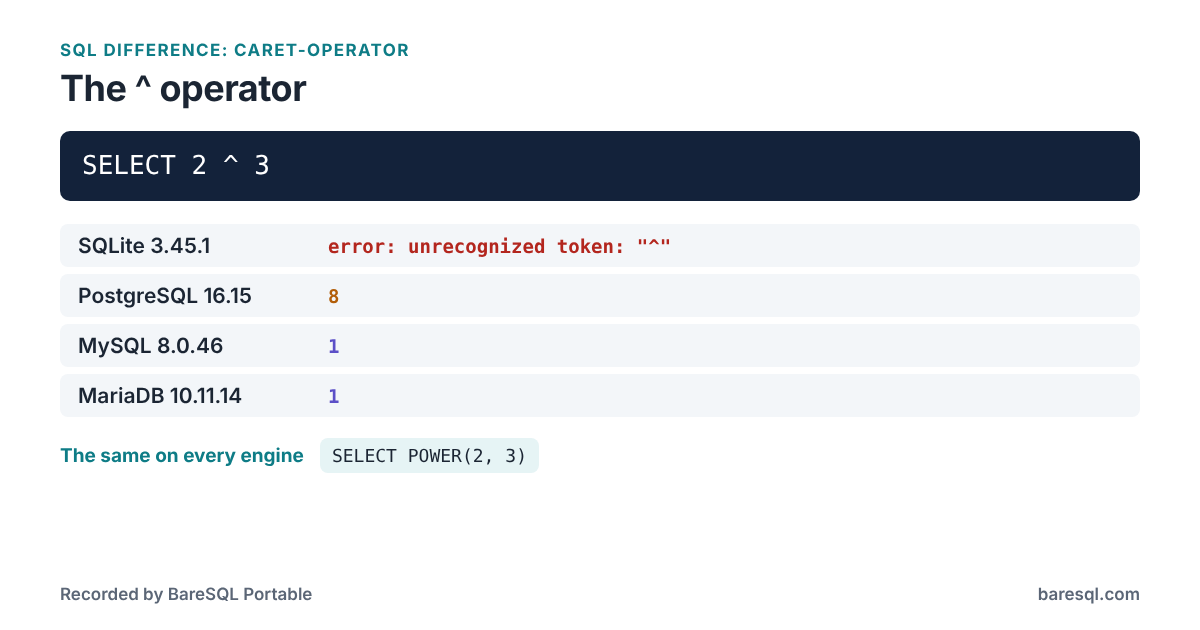
What Each Engine Answered
The example
SELECT 2 ^ 3;
gave these answers:
| Engine | Answer |
|---|---|
| SQLite 3.45.1 | error: unrecognized token: "^" |
| PostgreSQL 16.15 | 8 |
| MySQL 8.0.46 | 1 |
| MariaDB 10.11.14 | 1 |
The SQLite answers assume a build with math functions.
What to Write Instead
This form answers the same on every engine:
SELECT POWER(2, 3);
| Engine | Answer |
|---|---|
| SQLite 3.45.1 | 8.0 |
| PostgreSQL 16.15 | 8 |
| MySQL 8.0.46 | 8 |
| MariaDB 10.11.14 | 8 |
Use POWER(a, b), which all four engines have (SQLite when it is built with its math functions).
What BareSQL Portable Reports
Saved as example.sql, the example gets this from baresql lint --all:
$ baresql lint --all example.sql
example.sql:1:8: error: 2 ^ 3 is 8 on PostgreSQL, where ^ is a power, 1 on MySQL and MariaDB, where it is a bitwise exclusive or, and an error on SQLite. [caret-operator]
    2 ^ 3
    Use POWER(a, b), which all four engines have (SQLite when it is built with its math functions).

1 problem: 1 error.
baresql rules caret-operator prints the same answers in the terminal, and the BareSQL Portable page lists every difference BareSQL knows.