GROUP BY Counts Berlin and berlin as One City on MySQL and Two on PostgreSQL
A report counts sign-ups per city. On PostgreSQL and SQLite, Berlin and berlin are two rows. On MySQL and MariaDB they are one, and the count beside it is the sum of both.
MySQL and MariaDB compare text with a case-insensitive collation by default (see Text comparisons and letter case), and grouping and removing duplicates use the same comparison. The spelling that stands for a group is the one the engine happened to see first. On SQLite and PostgreSQL each spelling is its own group.
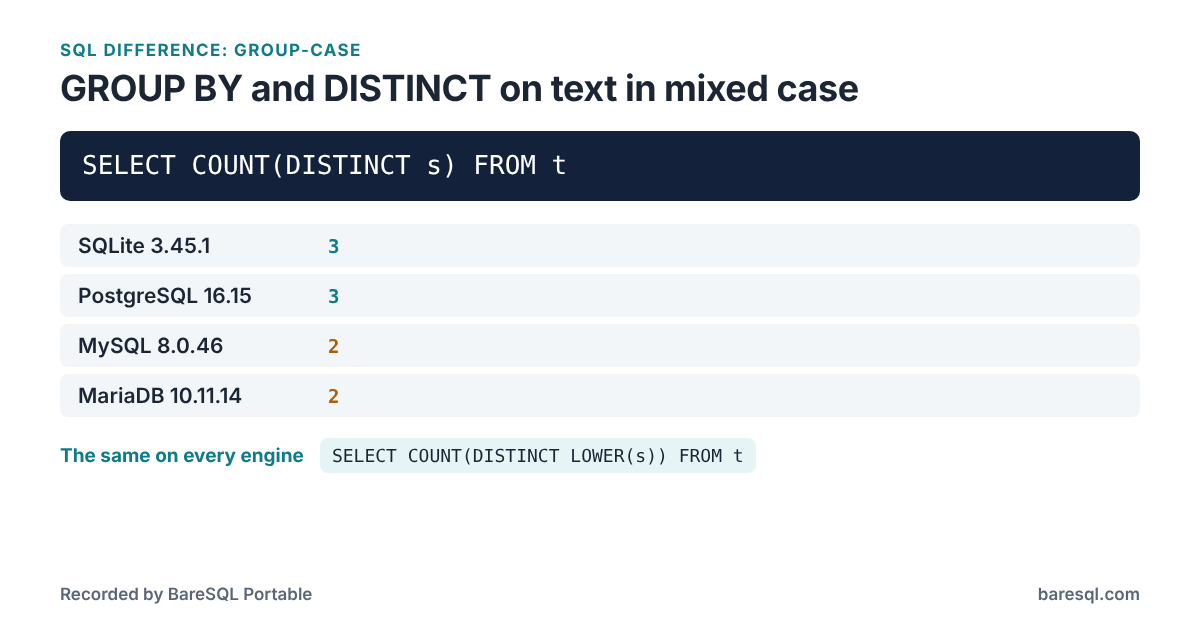
What Each Engine Answered
On a table made with
CREATE TABLE t (s VARCHAR(10));
INSERT INTO t VALUES ('x'), ('X'), ('y');
the example
SELECT COUNT(DISTINCT s) FROM t;
gave these answers:
| Engine | Answer |
|---|---|
| SQLite 3.45.1 | 3 |
| PostgreSQL 16.15 | 3 |
| MySQL 8.0.46 | 2 |
| MariaDB 10.11.14 | 2 |
Every Form BareSQL Checks
BareSQL Portable checks 4 forms of this, and each was run on all four engines. yes means the engine ran it and the engines that ran it agreed, no means the engine refused it, and a value is what the engine answered where they disagreed.
| Form | SQLite | PostgreSQL | MySQL | MariaDB |
|---|---|---|---|---|
GROUP BY |
3 |
3 |
2 |
2 |
DISTINCT |
3 |
3 |
2 |
2 |
COUNT(DISTINCT) |
3 |
3 |
2 |
2 |
UNION |
4 |
4 |
2 |
2 |
What to Write Instead
This form answers the same on every engine:
SELECT COUNT(DISTINCT LOWER(s)) FROM t;
| Engine | Answer |
|---|---|
| SQLite 3.45.1 | 2 |
| PostgreSQL 16.15 | 2 |
| MySQL 8.0.46 | 2 |
| MariaDB 10.11.14 | 2 |
Group on LOWER(s) to merge spellings on every engine, as in SELECT LOWER(s), COUNT(*) FROM t GROUP BY LOWER(s). To keep them apart on MySQL and MariaDB instead, give the column a binary collation there.
What BareSQL Portable Reports
Saved as example.sql, the example gets this from baresql lint --all:
$ baresql lint --all example.sql
example.sql:3:8: info: GROUP BY, DISTINCT, COUNT(DISTINCT) and UNION treat 'x' and 'X' as one value on MySQL and MariaDB and as two on SQLite and PostgreSQL. [group-case]
    COUNT(DISTINCT s)
    Group on LOWER(s) to merge spellings on every engine, as in SELECT LOWER(s), COUNT(*) FROM t GROUP BY LOWER(s). To keep them apart on MySQL and MariaDB instead, give the column a binary collation there.

1 problem: 1 note.
baresql rules group-case prints the same answers in the terminal, and the BareSQL Portable page lists every difference BareSQL knows.