COUNT With FILTER Works on PostgreSQL and SQLite and Fails on MySQL and MariaDB
A dashboard counts paid and unpaid orders in one pass with COUNT(*) FILTER (WHERE paid). PostgreSQL and SQLite run it, and MySQL and MariaDB stop at FILTER with a syntax error.
FILTER is standard SQL and limits the rows one aggregate sees, so one query can count several subsets of a table. SQLite reads it from 3.30 and PostgreSQL from 9.4. MySQL and MariaDB refuse it as a syntax error.
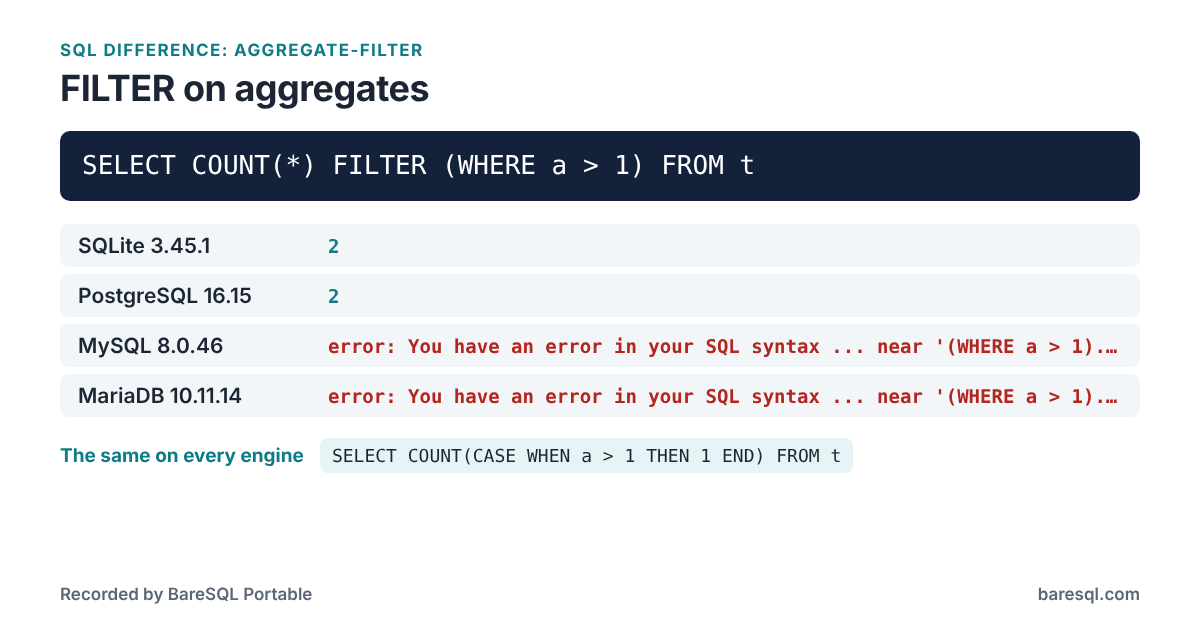
What Each Engine Answered
On a table made with
CREATE TABLE t (a INTEGER);
INSERT INTO t VALUES (1), (2), (3);
the example
SELECT COUNT(*) FILTER (WHERE a > 1) FROM t;
gave these answers:
| Engine | Answer |
|---|---|
| SQLite 3.45.1 | 2 |
| PostgreSQL 16.15 | 2 |
| MySQL 8.0.46 | error: You have an error in your SQL syntax ... near '(WHERE a > 1) FROM t' at line 1 |
| MariaDB 10.11.14 | error: You have an error in your SQL syntax ... near '(WHERE a > 1) FROM t' at line 1 |
What to Write Instead
This form answers the same on every engine:
SELECT COUNT(CASE WHEN a > 1 THEN 1 END) FROM t;
| Engine | Answer |
|---|---|
| SQLite 3.45.1 | 2 |
| PostgreSQL 16.15 | 2 |
| MySQL 8.0.46 | 2 |
| MariaDB 10.11.14 | 2 |
Move the condition into a CASE inside the aggregate: COUNT(CASE WHEN a > 1 THEN 1 END) counts the same rows, and SUM(CASE WHEN a > 1 THEN a END) adds the same values.
What BareSQL Portable Reports
Saved as example.sql, the example gets this from baresql lint --all:
$ baresql lint --all example.sql
example.sql:3:8: error: COUNT(*) FILTER (WHERE ...) works on SQLite and PostgreSQL; MySQL and MariaDB have no FILTER clause. [aggregate-filter]
    COUNT(*) FILTER (WHERE a > 1)
    Move the condition into a CASE inside the aggregate: COUNT(CASE WHEN a > 1 THEN 1 END) counts the same rows, and SUM(CASE WHEN a > 1 THEN a END) adds the same values.

1 problem: 1 error.
baresql rules aggregate-filter prints the same answers in the terminal, and the BareSQL Portable page lists every difference BareSQL knows.